Komodo's Bold Leap: Why Network Delays Are a Stepping Stone to a Decentralized Future

Recent block confirmation delays of up to few hours on the Komodo (KMD) network have raised questions among users and exchanges. However, the network remains stable and secure, delays are a transient byproduct of a broader architectural evolution - one that positions the KMD chain for significantly improved throughput and finality in the near term.
Concerns regarding the health of the Komodo network emerged recently as the time between blocks occasionally stretched from minutes to several hours. The network's peer-to-peer functionality and node software, including komodod and the KomodoOcean GUI wallet, are operating as intended. Development remains active, with recent commits to the project's repositories confirming ongoing support.
The root cause of these delays is a significant hard fork that occurred at block height 4,771,595. This update, dubbed the "dPoW SunSet," fundamentally altered the network's consensus mechanism by removing the delayed Proof-of-Work (dPoW) protocol and the associated Notary Nodes.
Previously, Notary Nodes played a crucial role in the ecosystem. They were permitted to mine blocks at minimal difficulty, ensuring that even with high network difficulty, a new block would be found within a predictable timeframe. This system provided a consistent rhythm to the blockchain.
With the deprecation of dPoW, Komodo has transitioned into a pure Proof-of-Work (PoW) blockchain. This move significantly enhances the network's decentralization, as block creation now rests entirely in the hands of independent miners and mining pools. While this aligns with the core ethos of many decentralized systems, it also introduces a new dependency: the network's progression is now directly tied to miner participation. In short, if miners don't produce blocks, the chain pauses.
The network's Difficulty Adjustment Algorithm (DAA) is designed to manage this. If blocks are not found within the expected window, the DAA automatically lowers the mining difficulty to incentivize miners and facilitate block production. This ensures the chain eventually moves forward, though it does not eliminate the possibility of significant delays if hashrate suddenly drops.
The hard fork also resulted in the creation of Komodo Classic (KMDCL), a parallel chain that preserves the original consensus rules envisioned by Komodo's founder, jl777. KMDCL retains the dPoW mechanism, Notary Nodes, private transactions, and a 5% active user reward (AUR). At the time of the fork, all KMD holders who controlled their private keys received an equivalent balance of KMDCL, in a manner similar to the 2017 fork that created Bitcoin Cash (BCH) from Bitcoin (BTC).
More importantly, the current state of block delays on the KMD network is a temporary, transitional phase. Following the acquisition of the Komodo ecosystem by Gleec, the combined team is actively developing an alternative, EVM-compatible network. This next-generation chain is already in a testnet phase and promises block generation times of approximately 2.5 seconds.
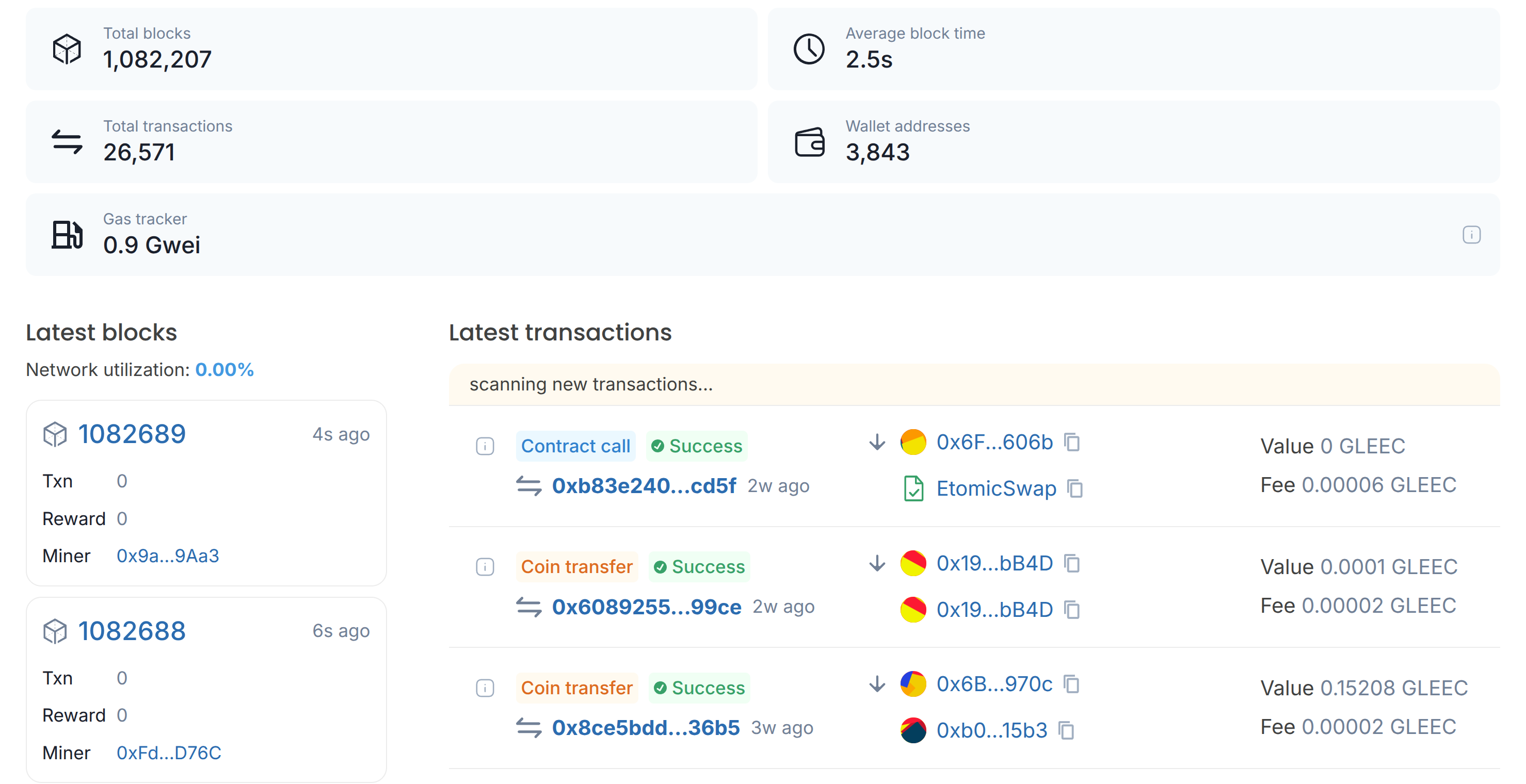
Upon its launch, the main Komodo (KMD) coin will be relaunched as a token on this new, high-speed network, rendering the current PoW-related delays obsolete.
For further updates, follow official announcements from Gleec and Komodo across their social media channels.