Hop Swap: A Clean, Non-Custodial Cross-Chain Swap Interface Built on LI.FI


Routing tokens across blockchains shouldn't require a PhD in bridge architecture. Hop Swap makes it a three-click operation — without ever touching your keys.
I've spent a fair amount of time watching people struggle with cross-chain swaps. The typical experience goes something like this: open a bridge, get confused by the UI, second-guess the route, pay too much in fees, then wait twelve minutes wondering if the transaction is stuck somewhere between Ethereum and Arbitrum. It's a solved problem in theory. In practice, most interfaces make it feel unsolved.
Hop Swap is my attempt to cut through that friction — and, frankly, an experiment in AI-assisted development: a real-world use case built from the ground up with AI tooling handling the bulk of the implementation work. It's a lightweight, non-custodial swap aggregator — a clean frontend that connects to the LI.FI protocol for route discovery and transaction execution. No accounts. No custody. No unnecessary complexity.
Why LI.FI?
LI.FI occupies a specific and genuinely useful niche in the DeFi infrastructure stack. Rather than being a bridge or a decentralized exchange (DEX) itself, it's an aggregation layer that sits on top of both — pulling routes from dozens of bridges (Stargate, Across, Hop Protocol, Celer, deBridge, and more) and DEXs (Uniswap, Curve, 1inch, Paraswap) simultaneously, then presenting the best available path for a given swap.
The practical upside is significant. When you want to move, say, ETH on Ethereum to USDC on Arbitrum, LI.FI doesn't just find you a bridge — it finds the optimal combination of bridge and DEX steps, accounting for fees, slippage, and execution time. It also handles the sequencing: if a route requires swapping before bridging, or bridging before swapping, LI.FI orchestrates that automatically.
The protocol has processed over $4 billion in volume across more than 20 supported chains, according to its own on-chain data. It's audited, battle-tested, and used by a number of well-known DeFi frontends as underlying infrastructure. That track record mattered when choosing a foundation to build on.
There's also a developer-facing reason: LI.FI exposes a clean REST API with a well-documented integrator program. This made it possible to build Hop Swap as a thin, stateless frontend — no proprietary backend logic, no order books, no off-chain matching. The heavy lifting stays with LI.FI's infrastructure; the interface just needs to ask the right questions and display the answers clearly.
What Hop Swap Actually Does
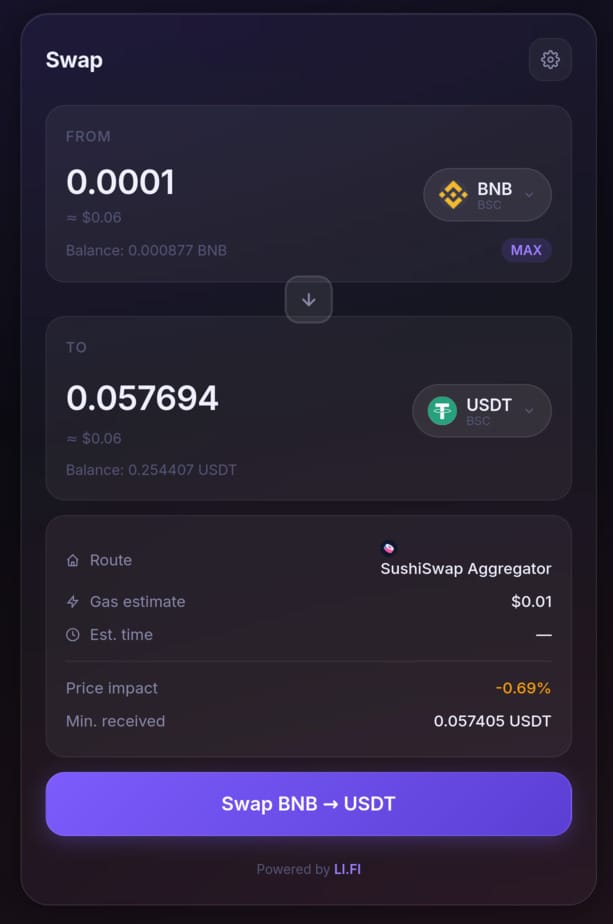
The interface is intentionally minimal. You select a source token and chain, a destination token and chain, enter an amount, connect a wallet, and execute. The route details — estimated output, fees, bridge protocol used, execution time — are displayed before you confirm anything.
A few design decisions worth noting:
No build toolchain, no framework overhead. The frontend is vanilla HTML, CSS, and JavaScript — ES modules loaded directly in the browser. There's no React, no webpack, no npm install step for the end user. The result is a page that loads fast and has a small attack surface.
Wallet support is broad. The interface supports any EIP-6963-compliant injected wallet (MetaMask, Rabby, Coinbase Wallet, Brave Wallet, and others detected automatically), plus WalletConnect v2 for mobile wallets — Trust Wallet, Rainbow, Ledger Live, and the rest of the WalletConnect ecosystem. Connection is handled client-side; the server never sees your address until you choose to interact.
The backend is a thin proxy, not a data store. A small Rust service (built on Axum) sits between the frontend and LI.FI's API. Its job is to inject the API key server-side — so it's never exposed in client-side code — and to cache high-traffic, low-volatility responses like chain lists and token lists. Chains are cached for one hour; token lists per chain are cached for ten minutes. This keeps the experience snappy while staying well within LI.FI's rate limits.
The Non-Custodial Guarantee
This is worth stating plainly: Hop Swap never holds funds, never has access to private keys, and never intermediates transactions. When you execute a swap, you're signing a transaction that interacts directly with LI.FI's audited smart contracts. The Hop Swap backend doesn't touch that transaction — it only helped you find the route.
The integrator fee (a small percentage collected via LI.FI's fee mechanism) is the only financial relationship between the service and the transactions it facilitates. Even that is collected by LI.FI on the integrator's behalf, not by any Hop Swap-controlled contract.
What's Next
The current release covers the core swap flow end to end. Where things go from here depends largely on whether the service sees real use — if it does, I'll keep iterating on the interface, tightening the UX, etc. based on actual user feedback.
If you want to try it: hop.decker.im. Connect a wallet, pick a pair, see what LI.FI finds. The interface is live and the routes are real.
Hop Swap is built and maintained by decker.im. The service is non-custodial and provided as-is; all swap execution is handled by LI.FI's protocol. LI.FI's own Terms and Conditions apply to the underlying transactions.