Accepting Crypto Payments on Your Website With KDF


Today, I want to continue exploring the capabilities of the Komodo DeFi Framework (KDF) and the breadth of its potential applications. In my previous article, I showed how KDF can serve as a building block for a non-custodial wallet for UTXO-based coins. This time, I am looking at another use case I touched on briefly before: accepting cryptocurrency payments on a website.
Anyone exploring self-hosted crypto checkout will likely have come across BTCPay Server. It is a mature, free, open-source Bitcoin payment processor that allows merchants to accept both on-chain Bitcoin and Lightning Network payments without an intermediary. 1 2 The project provides a full invoicing and checkout stack, rather than simply a transaction-monitoring service.
That breadth comes with a trade-off. A fully self-hosted BTCPay setup running both Bitcoin and Lightning nodes has documented minimum requirements of 2 GB of RAM, 80 GB of storage with pruning enabled, and Docker; operating Lightning yourself also means managing payment channels and liquidity. 3 That is the cost of a comprehensive, self-sovereign payment stack - not a criticism of BTCPay Server. But it may be more infrastructure than a developer needs for a focused crypto-payment flow.
KDF offers a different route. A developer can write a custom backend that watches for and verifies payments on a supported blockchain, then triggers the appropriate action inside the application. For UTXO assets, KDF can work in a lightweight mode through external Electrum servers; for supported platform chains, it can use external JSON-RPC endpoints. In either case, the application does not need to install a native chain daemon or keep a local blockchain synchronized. 4
Consider a storefront for digital goods: application source code, original photographs, or any other downloadable content. A site could allow a customer to unlock that content after paying in cryptocurrency. To demonstrate the idea, I built a small live proof of concept that offers sample text files in exchange for KMD. 5
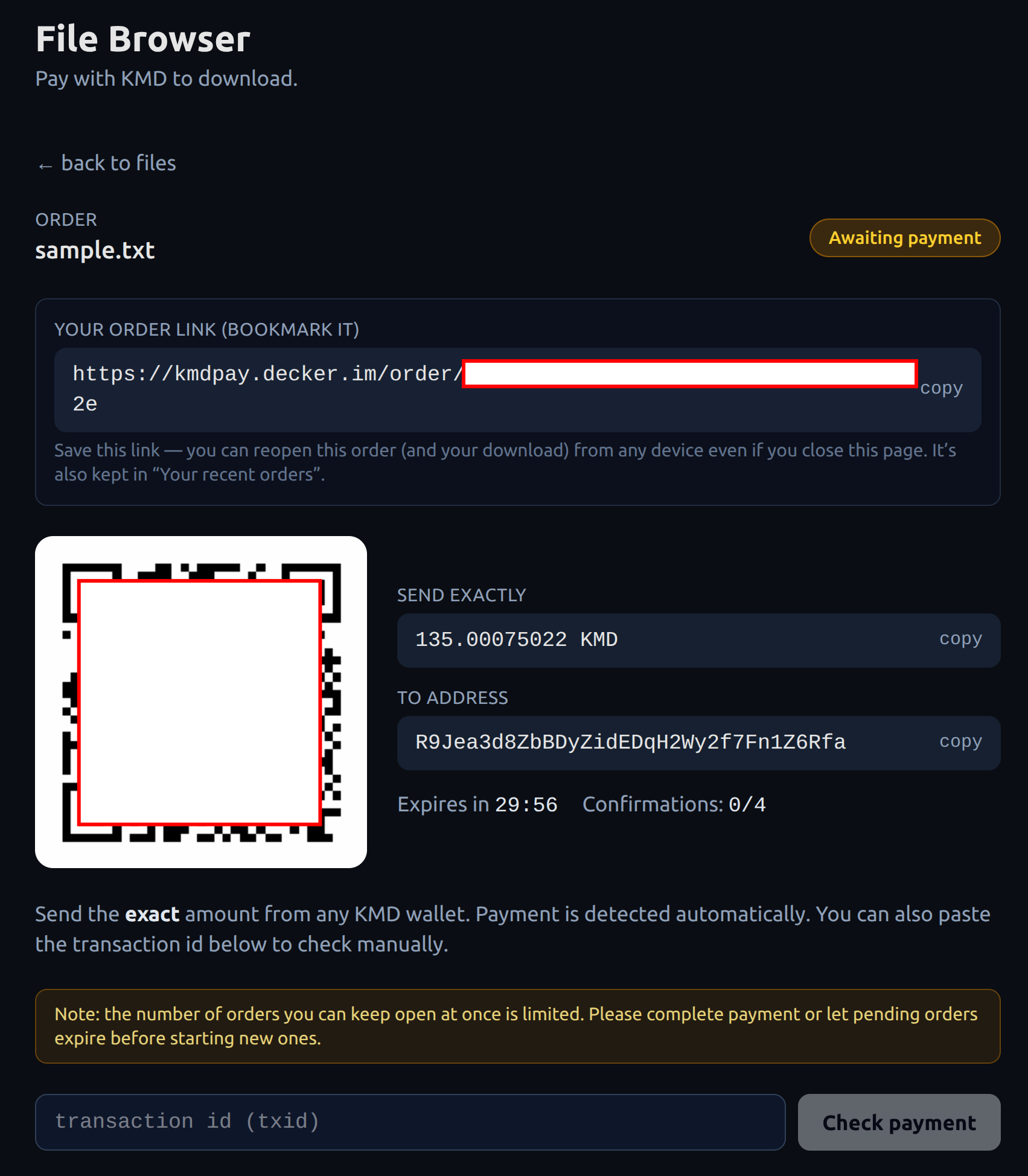
The demo uses KMD today, but the same architecture can be adapted for other supported UTXO assets or EVM-compatible tokens. The exact configuration will depend on the asset and the external Electrum or RPC infrastructure selected, but the key point remains the same: there is no requirement to run a local coin full node, synchronize a blockchain, or operate a conventional full-node stack just to detect a payment.
In my deployment, the active KDF instance consumes only a few hundred megabytes of memory (without DEX functionality).
That relatively small footprint can make a custom crypto-payment service practical even on a modest virtual private server (VPS), depending on traffic, the assets enabled, and the external services used.
The live demo is now available for testing at https://kmdpay.decker.im/ - interesting, isn't it? It still remains unclear to me why a project like KDF has gone unnoticed by the community and businesses. Because there are countless applications that can be built on top of it.
If you have any ideas - let's discuss them.