From UTXO to EVM: Expanding a KDF-Powered Web Wallet

In a follow-up to our previous dive into the Komodo DeFi Framework (KDF), we explore the latest updates to a lightweight, fully serverless web wallet - and what it reveals about the future of non-custodial architecture.
In my previous article, I walked through the process of building a fully non-custodial Web3 crypto wallet using the Komodo DeFi Framework (KDF). Originally developed by the Komodo team, KDF’s development is now spearheaded by specialists at Gleec - including former Komodo developers like myself - following Gleec’s acquisition of the full Komodo ecosystem in late 2025.
If you missed that piece, the core takeaway is this: KDF serves as a foundational building block that allows developers to create feature-rich decentralized finance (DeFi) applications using a single, unified framework. Under the hood, KDF is a Rust codebase that can be compiled into a standalone binary, a static or dynamic library, or WebAssembly (WASM) for the browser. This platform-agnostic approach means you can use KDF to build crypto applications for virtually any environment.
Furthermore, KDF’s broad protocol support - encompassing UTXO chains, EVM-compatible networks and ERC-20 tokens and Tron (TRX/TRC-20) - provides developers with the flexibility to interact with an estimated 90% of all existing cryptocurrencies [1]. You can explore the official KDF documentation on the Komodo Platform website, or check out the standalone documentation mirror that I recently built as a weekend project using Astro.
Expanding Protocol Support: From UTXO to Shielded and EVM Chains
In our first iteration, we built a web wallet that supported a handful of UTXO-based coins. Since then, I have expanded its capabilities to include Pirate Chain (ARRR). For context, Pirate Chain is a Komodo asset chain built on the Komodo and Zcash code lineages. It enforces privacy by default, meaning peer-to-peer transfers are shielded using zk-SNARKs, and users cannot send funds to transparent addresses for standard transactions [2].
I also integrated support for the base EVM chain for Gleec. At the time of the original writing, this network was in its testing phase [3].
A Serverless Architecture Built on WASM
I am excited to share the live result of this work at wallet.decker.im. The open-source code remains available on GitHub.
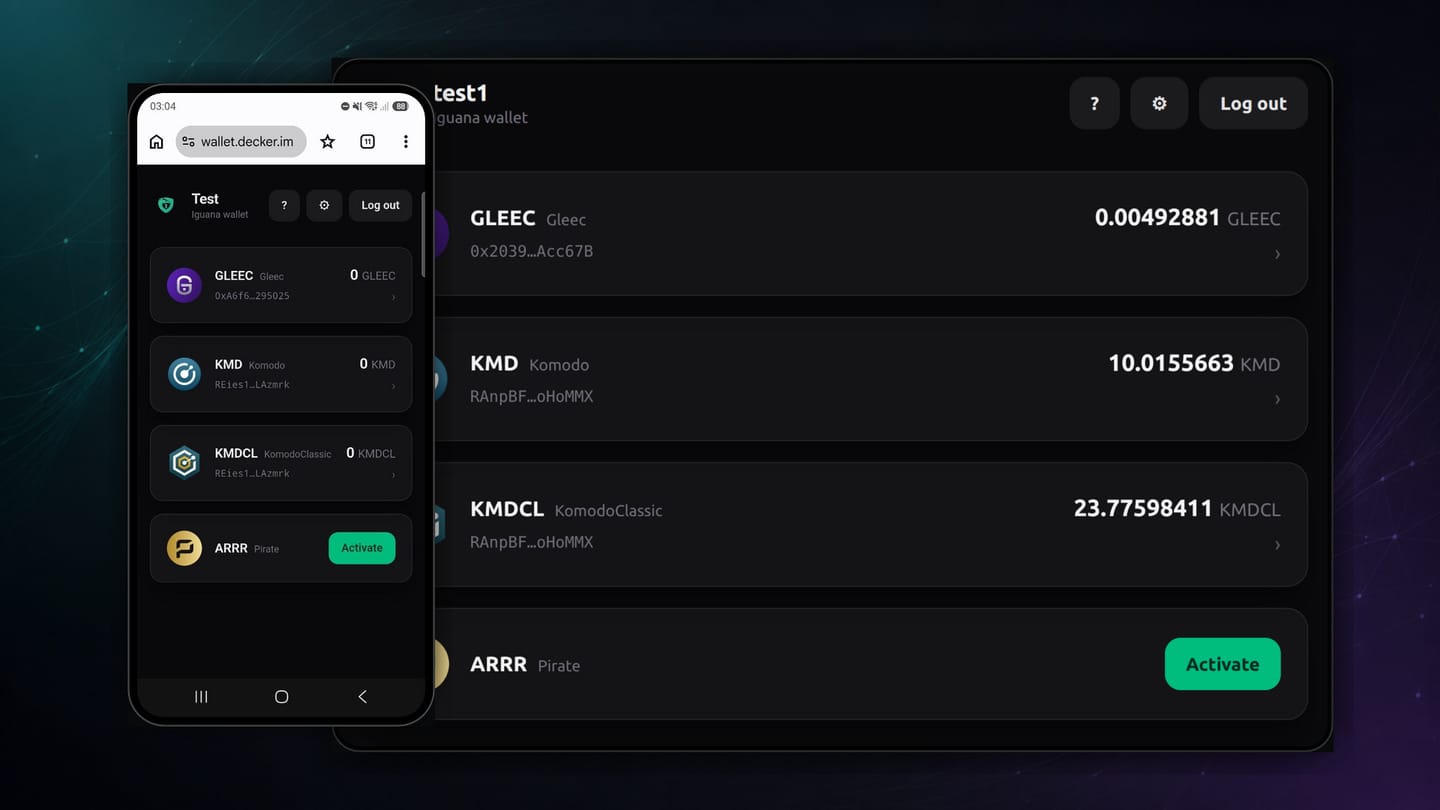
I am a developer, not a UI/UX designer, so the interface is intentionally austere. It is exactly the kind of wallet I want to use: minimal controls, no unnecessary tabs, and a relentless focus on speed. In practice, the wallet operates exactly as fast as your browser can execute the KDF WASM build.
That brings us to the most critical architectural point: this wallet has no backend. There is no centralized server controlled by me, Gleec, or anyone else processing your data. Instead, the KDF instance running in your browser communicates directly with public Electrum servers for UTXO coins via WebSocket Secure (WSS), and with public RPC nodes for EVM networks.
Because the KDF WASM module executes entirely client-side, transaction signing happens locally. Your private keys never leave your browser; the only data transmitted to the outside world are the cryptographically signed transactions.
Naturally, trusting a web browser with cryptocurrency storage is a debated topic, and many users rightfully hesitate to store substantial wealth in browser-based wallets or extensions. Ultimately, your funds are only as secure as the browser environment itself. However, for smaller balances, day-to-day transactions, and interactions with trusted software providers, a non-custodial browser wallet is a highly practical solution.
(Note: While the core KDF framework supports hardware wallets like Trezor, that integration is not yet implemented in the wallet.decker.im web interface.)
Looking Ahead
Currently, I do not have a rigid roadmap for expanding this specific web wallet. My primary goal was to demonstrate the power and flexibility of KDF to other developers. That said, if the community finds this web version valuable and the feedback is strong, I may continue building out its feature set.
Until then, I welcome your thoughts and comments on social media.
References
[1] Komodo DeFi Framework Introduction
[2] Pirate Chain White Paper v3
[3] Gleec EVM Mainnet Information